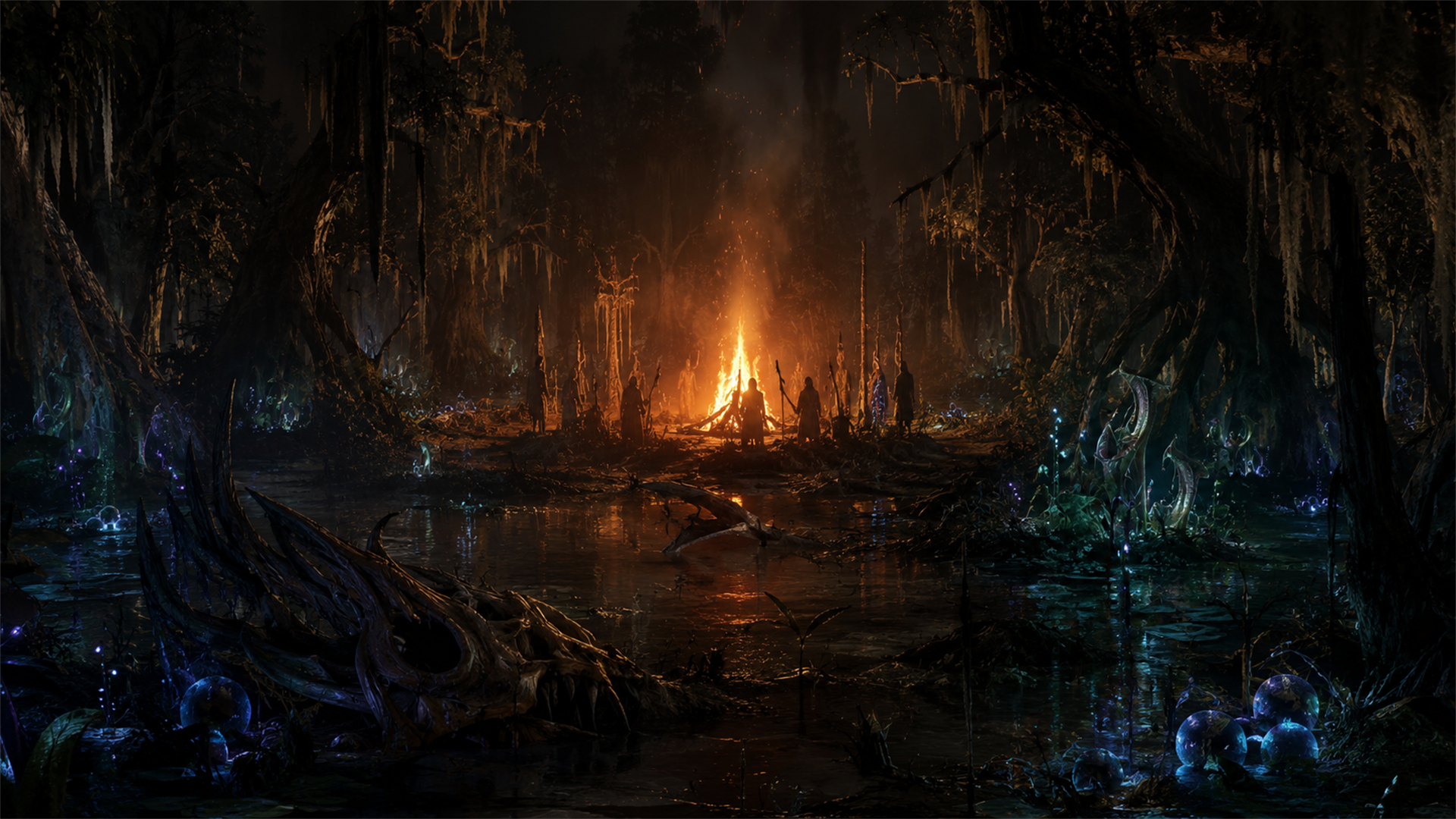
The first chapter of Prime Dominance: The Oathbound Guardian opens in the sort of place where comfort has clearly lost the argument. A swamp at night. Firelight. Mud, smoke, old growth, and enough humidity to make every breath feel like a negotiation. It is not a soft beginning, and that is part of why I like it.
Some stories begin by handing the reader a map. This one begins by handing a young man ash and salt.
The narrator sits among nearly fifty others, all marked for the same passage into adulthood. They are not children anymore, but they have not yet earned the right to call themselves adults. That distinction matters. Modern people often blur those lines until everyone is either permanently adolescent or prematurely cynical. The Aeylah’tha’nah do not have that luxury. Their world is too hungry for vague self-esteem. Tomorrow will test them, and the chapter lets us feel that before it explains anything.
I have always been drawn to threshold moments in fiction. The night before the battle. The hour before the vow. The last meal before the road bends and refuses to bend back. In Chapter 1, the trial has not begun yet, but the cost of it is already present. The young narrator is sitting upright because duty has a posture. His hands are still because fear has discipline. Around him are familiar faces made strange by firelight, and over all of them hangs the knowledge that childhood is ending whether they feel ready or not.
That is a very old kind of scene, and it should be. A society that cannot tell its young people what they are inheriting will eventually hand them nothing but appetite and confusion. The Aeylah’tha’nah are poor in many ways, exiled in many ways, and despised by outsiders who call them waste elves with the usual laziness of people who prefer insults to thought. But they still have memory. They still have ritual. They still have a story strong enough to make a marked youth sit still when every reasonable nerve in his body would rather be somewhere else.
At the center of the fire circle stands the Herald. I enjoy a good Herald. Not the decorative sort who exists to announce banquets and wear hats that should require engineering permits, but the older kind: the living memory of a people. He carries no weapon because his voice is weapon enough. That is not a small thing. In a world built from collapse, mutation, hunger, and old tyrannies crawling out from under the floorboards, the story itself has become a blade.
The origin he tells is not flattering to the old world. It rarely is, once someone has had time to count the bodies.
There were towers, machines, nations, measurements, and men who assumed that mastery was the same thing as wisdom. Then came fire, poison, hunger, and collapse. The powerful fled underground, preserving knowledge and command, which is a rather tidy way of saying they survived with their habits intact. Survival alone might have been noble. Survival married to ownership becomes something else. The old rulers wanted the surface back, but the surface had changed. Radiation, mana storms, poisoned air, mutated forests, and predators had turned the world into a very firm rebuttal.
So they went looking for a tool.
What they found was the seed, or something close enough to a seed that language gave up and settled for the nearest word. Alien, ancient, alive with patterns nobody in the bunker truly understood, it became the center of their experiment. Human bloodlines, radiation, mana, and the seed’s own impossible power were woven together into a new people: golden-skinned, emerald-eyed, strong enough to breathe where others died, quick enough to heal, human enough to love, remember, question, and resist.
That last part is where tyrants always get careless.
They can imagine bodies as tools. They can imagine strength as an asset. They can imagine obedience as a design feature. What they rarely imagine, because it would be inconvenient, is the soul. Give a created people memory, language, grief, friendship, hunger, and children, and sooner or later they will notice they were not made merely to be useful. They will notice that personhood is not something granted by the powerful as a workplace benefit.
The New People were released into broken lands to reclaim a world for masters who intended to arrive later and collect the invoice. Many died. Hunger, beasts, sickness, weather, and violence took their share. But those who lived learned the swamp paths. They learned which plants cured and which killed. They learned to fight men with too few morals and creatures with too many teeth. More importantly, they learned to speak to one another not as instruments, but as kin.
That is the moral hinge of the chapter.
The rebellion matters, of course. The bunker falls. The seed is taken from the hands that would have owned all life. The ancestors carry it south into the mutated lands once called Florida and plant it where the old men will not follow. There is a fine satisfaction in that image: roots going down where maps and empires have already failed. Georgia, Mississippi, Alabama, all the old names swallowed by water, root, and radiant growth. The world does not become safe. It becomes home.
But the deeper movement is quieter than the revolt itself. It is the change from use to inheritance. The young narrator hears the story not as a child’s grand tale, but as something that has finally placed its hand on his shoulder. The ash on his forehead is no longer decoration. It is no longer merely a custom performed by elders because elders enjoy inventing procedures that make the young uncomfortable. It is a mark tied to blood, promise, loss, and obligation.
This is why the Herald’s final line lands so cleanly: “This is why tomorrow matters.”
Not because the trial is dramatic, though it surely is. Not because a young person wants status, though every sixteen-year-old in any world would probably enjoy being taken seriously for once. Tomorrow matters because a people who were designed as property became oath-bound survivors, and someone must carry that oath forward. Freedom, in this chapter, is not treated as a mood. It is not a slogan, and it is certainly not a permission slip to drift. Freedom is a debt to the dead and a duty to the living.
That is the part I find most interesting about The Oathbound Guardian. The chapter is full of striking images: fire on metallic skin, silver braids, emerald eyes, bunker shadows, a living crystal seed, radiant swamp groves, carnivorous trees rising like cathedrals with poor manners. But the images work because they serve the inner turn. A young man begins the night afraid of a trial. He ends it understanding that the trial is only the doorway. Beyond it is the cost of belonging to a people who chose to become more than what their makers intended.
There is no cheap comfort in that. Good. Cheap comfort does not survive long in a swamp.
What remains is steadier: a bowed head, a fire burning low, a mother’s braids against the neck, and the knowledge that inheritance is not something we admire from a safe distance. At some point, if the story is doing its work, inheritance asks something of us.
Tomorrow, for the narrator, is when the asking begins.