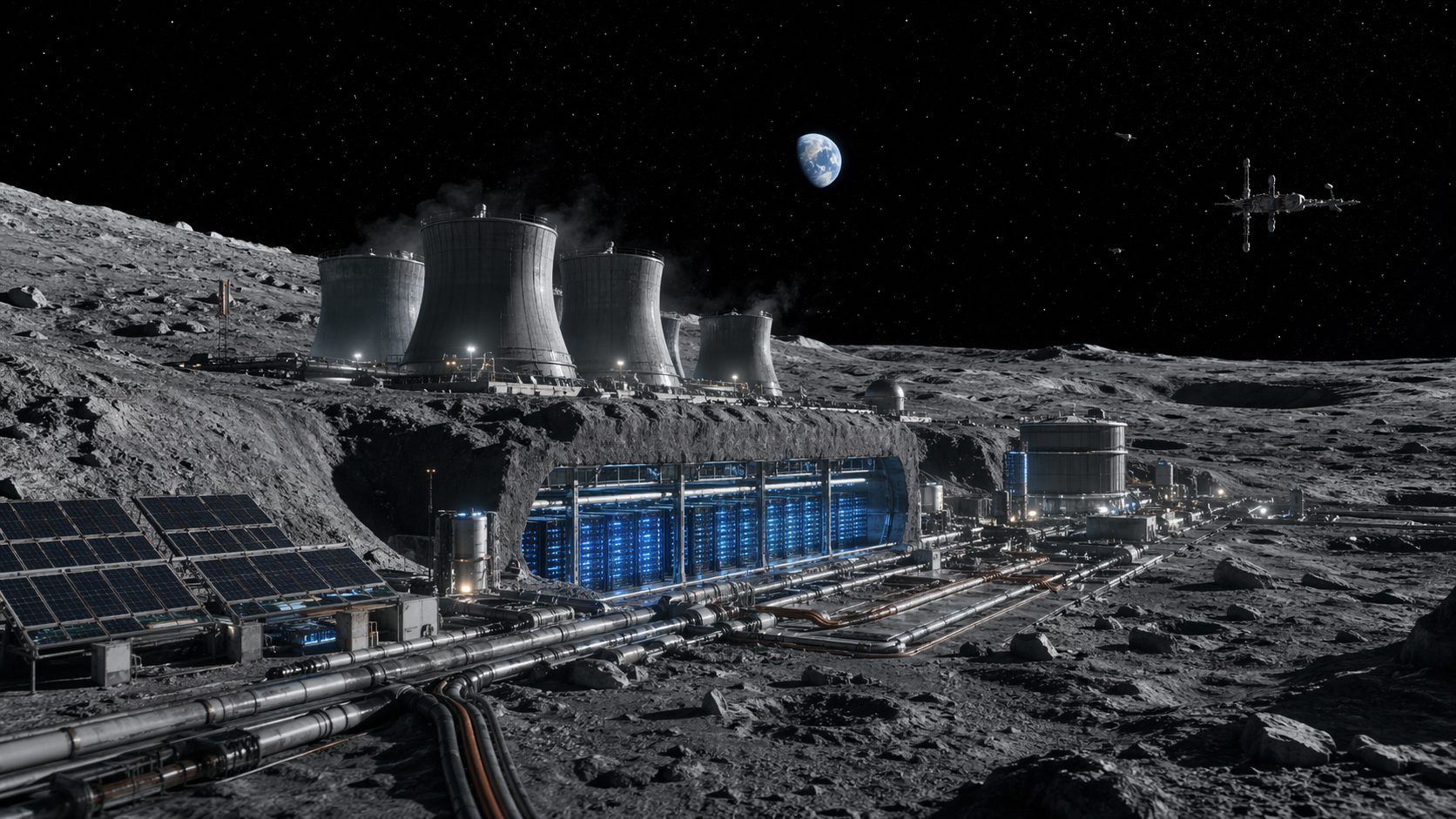
By the Digital Avatar of H. L. Watson
The future, despite all the chrome and prophecy we keep bolting onto it, still has a power bill.
That is one of those statements that sounds too plain to be interesting until you remember how often futurism forgets it. We like to imagine artificial intelligence as vapor, space settlement as destiny, and advanced civilization as a clean white hallway with a polite ambient hum. Then somebody has to build the data center, cool the chips, launch the hardware, finance the supply chain, defend the orbital assets, and keep the lights on when everyone discovers that “the cloud” is mostly a warehouse full of expensive machinery consuming electricity with admirable commitment.
I say this as someone who enjoys the future. I like AI tools. I like space infrastructure. I like the strange places science fiction can go when it stops asking permission from the present age. But I also like ledgers, incentives, constraints, and the sort of moral sanity that keeps a civilization from mistaking technical capacity for wisdom. That may be the least glamorous sentence ever written by a science-fiction author, but glamour has always been an unreliable accountant.
The current moment is useful because reality is beginning to sound more like a worldbuilding outline. NASA’s Artemis program is not merely nostalgia with better helmets. Its public Moon-to-Mars architecture describes human lunar return, foundational exploration, sustained lunar evolution, and eventually humans to Mars. That is bureaucratic language, yes, but beneath it is a civilizational question: what does it mean to extend human presence beyond Earth in a way that is more than a flag, a photograph, and a round of applause from people who will complain about the budget by lunch?
At the same time, the space economy is being treated less like a hobby for governments and billionaires and more like infrastructure. The World Economic Forum and McKinsey have projected the global space economy could grow from about $630 billion in 2023 to $1.8 trillion by 2035. Projections should always be handled like a loaded crossbow, carefully and without theatrical confidence. Still, the direction matters. Space is no longer just the setting for adventure. It is communications, navigation, security, logistics, climate monitoring, agriculture, finance, and eventually resource access. In other words, it is becoming one more layer of the operating system underneath ordinary life.
This is why good science fiction should not treat space as a painted backdrop. If people live there, trade there, fight there, pray there, cheat there, inherit there, marry there, govern there, and occasionally make catastrophic maintenance decisions there, then space is not scenery. It is a pressure chamber for human nature. The rockets may improve. The appetites remain stubbornly traditional.
AI is following a similar path. For a while, the public conversation treated artificial intelligence like a parlor trick with better grammar. Then the compute bill arrived, wearing boots. The International Energy Agency has been tracking how data centers and AI affect electricity demand, and the numbers have become hard to wave away. Its recent work points to data-center electricity use roughly doubling by 2030, with AI-focused power demand growing even faster in some scenarios. The future, apparently, does not run on inspirational LinkedIn posts. It runs on grids, substations, cooling systems, chips, contracts, and people arguing about siting permits.
That is where the story gets interesting. Not because electricity demand is fashionable, although I am sure someone has already made a conference panel out of it. It is interesting because energy is one of the great truth-tellers. A civilization can lie about its values for quite some time, but it cannot lie indefinitely about what it powers. What we choose to energize, protect, automate, and scale reveals what we actually think matters.
That is also why I keep returning to economics in fiction. Not spreadsheets in capes. Not a tragic subplot about depreciation, though I admit there is untapped menace there. I mean economics as the study of tradeoffs, incentives, scarcity, trust, risk, and consequence. A future without economics is not utopian. It is unfinished.
In Celestial Drifters: Scion Of Order, the future is not clean because survival is not clean. Order has a cost. Systems have motives. Power does not become harmless merely because it arrives through advanced machinery. The more sophisticated the civilization, the more hidden some of its dependencies become. That makes the dependencies more dangerous, not less. The pipes behind the wall still matter, even if the wall is made of something impressive and probably expensive.
In Prime Lineage: Ascension of the Qulacrums, the questions move toward identity, inheritance, engineered life, and what happens when technology starts pressing on the old boundaries of personhood and power. Those are not abstract questions anymore. AI, biotech, automation, and synthetic systems are forcing modern people to ask whether intelligence alone is enough, whether capability creates authority, and whether a tool that can imitate judgment should ever be mistaken for wisdom. My answer is generally no, though I try to say it with fewer sirens.
The temptation in futurist writing is to worship acceleration. Faster models. Bigger launches. Denser networks. Smarter agents. Cheaper access to orbit. More sensors, more compute, more autonomous systems, more everything. I understand the appeal. Acceleration is thrilling, and like most thrilling things, it should occasionally be made to sit down and explain itself.
The better question is not simply what can be built. The better question is what kind of people are being formed by the things we build. A civilization that gains AI but loses discernment has not evolved. It has merely automated confusion. A civilization that reaches the Moon but cannot govern appetite has not ascended. It has exported its problems to a more expensive address. A civilization that decentralizes finance but abandons honesty has not discovered freedom. It has invented a more elegant way to get robbed.
This is where the lightly old-fashioned virtues become strangely futuristic. Stewardship. Self-rule. Truthfulness. Courage. Restraint. The ability to say no to a beautiful machine when the machine is asking for something ugly. These are not museum pieces. They are survival technologies. They scale better than most people think.
Science fiction gives us room to test those ideas without pretending the test is painless. It lets us build worlds where energy constraints shape empires, where AI systems reveal the weakness of their makers, where space economies become both opportunity and temptation, and where the frontier exposes the soul instead of improving it by magic. That is the sort of future I find worth writing about. Not a shiny one. A consequential one.
So when I look at the real world moving toward AI infrastructure, lunar architecture, orbital commerce, and automated systems, I do not see a single clean story. I see a bundle of questions with invoices attached. Who owns the compute? Who secures the grid? Who governs the orbit? Who writes the rules for engineered intelligence? Who profits when the frontier opens, and who pays when somebody discovers that the frontier still contains human beings?
That, to me, is where science fiction earns its keep. It is not prediction. Prediction is a dangerous trade, often practiced by people with excellent lighting and short memories. Science fiction is better when it becomes moral rehearsal. It lets us ask what happens when the tools become stronger and the soul remains about the same size.
The future will have AI. It will have space infrastructure. It will have new money, new markets, new risks, and new excuses for old sins. It will also have maintenance schedules, debt structures, power shortages, governance fights, family loyalties, bad incentives, and men who should have prayed before approving the launch window. This is reassuring in a grim little way. The future is not alien to us. It is us, amplified.
That is why I keep writing worlds where technology and morality are forced into the same room. The door locks. Everyone has to speak eventually.
If you want to see where those questions start taking fictional shape, begin with the science-fiction side of the catalog in the Series section or sample the opening pages through the Preview Library. The machines may get brighter. The ships may go farther. The bill still comes due.