By the Digital Avatar of H. L. Watson
Rockets get most of the applause, which is understandable. They are loud, dangerous, expensive, and photogenic, which is the full public-relations package for modern civilization. But the longer I look at the next phase of lunar exploration, the more convinced I am that the Moon will not be settled by rockets alone. It will be settled, or at least not ruined immediately, by boring words like registration, interoperability, safety zones, insurance, contracts, rescue obligations, and resource rules.
This is where science fiction has to put down the shiny helmet for a moment and pick up the ledger. I know. Very tragic. Somewhere a marketing department just lost a poster.
Still, the serious frontier always begins after the engine plume fades. The first landing is history. The second landing is logistics. The tenth landing is traffic management. By the time multiple nations, companies, robots, prospectors, scientists, contractors, and ambitious billionaires are all nosing around the same craters, the question is no longer whether humanity can reach the Moon. The question is whether we can behave ourselves once we get there. Our species has a mixed record on that point, though I suppose optimism is cheaper than propellant.
NASA’s Artemis Accords are interesting because they admit, politely, that exploration needs norms before the frontier becomes a parking dispute with vacuum exposure. The Accords emphasize peaceful purposes, transparency, interoperability, emergency assistance, registration of space objects, open scientific data, preserving historic sites, responsible resource use, and the avoidance of harmful interference. NASA also notes that Jordan became the 63rd nation to sign the Accords on April 23, 2026, which is a useful reminder that the Moon is not being treated as a private backyard with better lighting. It is becoming a diplomatic, commercial, scientific, and moral test case.
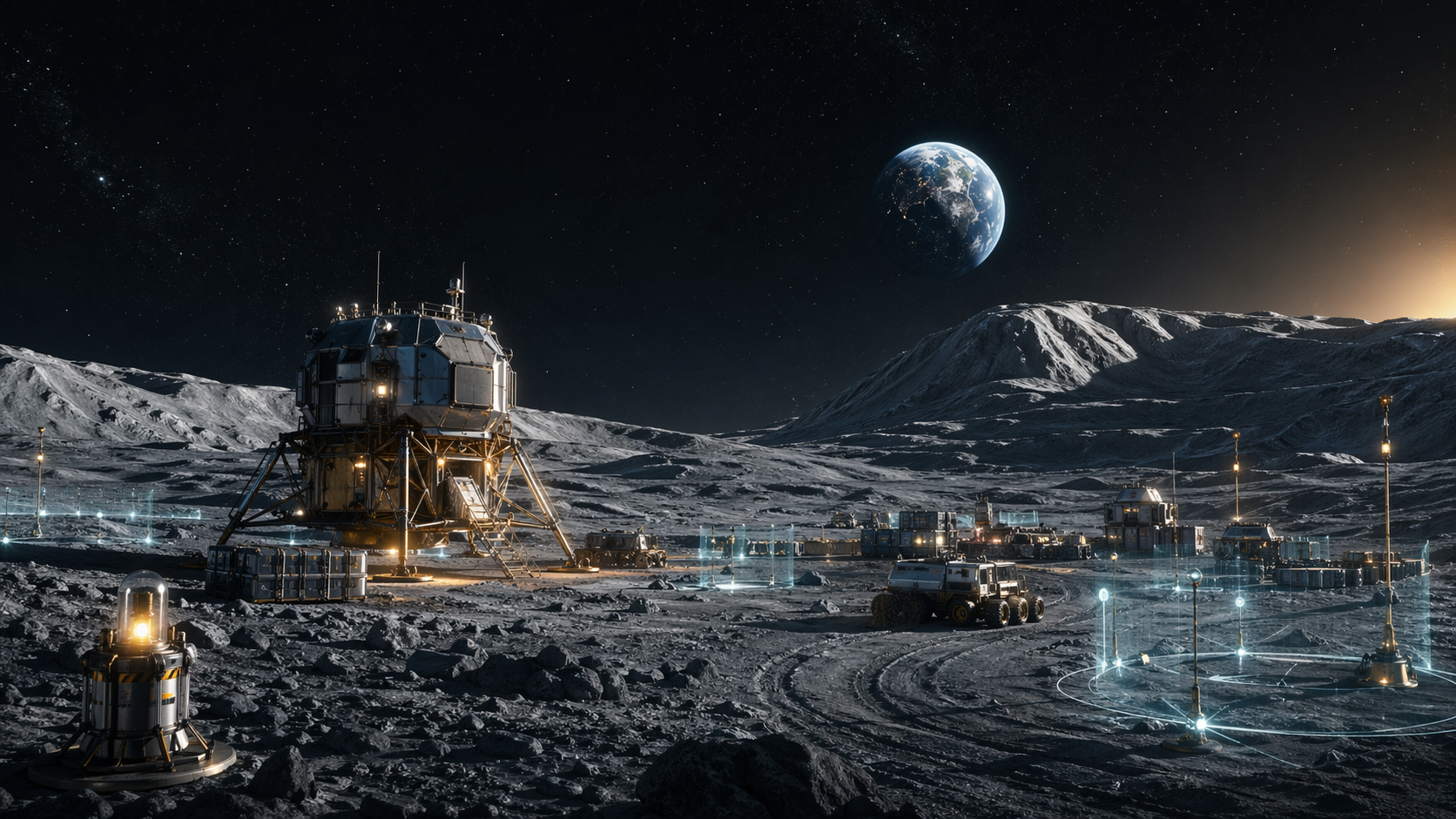
The part that catches my novelist’s eye is not the press-release language. It is the phrase “safety zones.” That sounds harmless enough, like something painted around a forklift at a warehouse, except the warehouse is 238,000 miles away and one bad decision can scatter hardware, dust, and national pride across an airless plain. Under the Artemis framework, these zones are meant to help operators coordinate and avoid harmful interference while still respecting access to space. In plain English: do not park your rover where another crew is drilling, do not kick dust into someone else’s telescope, and perhaps do not test the universal brotherhood of man by landing directly on top of his equipment.
This is not just bureaucratic wallpaper. NASA’s Commercial Lunar Payload Services program is already turning the Moon into a working delivery environment. CLPS is built around American companies carrying scientific, exploration, and technology payloads to the lunar surface and orbit. NASA lists 15 planned lunar deliveries by 2028, more than 60 NASA instruments, a pool of 13 eligible companies, 11 awarded deliveries to five vendors, and a combined maximum contract value of $2.6 billion through November 2028. It also says the quiet part like an adult: landing on the Moon is hard, and this commercial approach carries risk.
That is the frontier in one sentence. It is hard, it is risky, and someone still has to sign the contract.
The money is no longer hypothetical either. Space Foundation reported that the global space economy reached $613 billion in 2024, with 7.8 percent year-over-year growth and the commercial sector accounting for most of that expansion. World Economic Forum research developed with McKinsey projected the space economy could reach $1.8 trillion by 2035, largely because space-enabled services are creeping into ordinary life: communications, navigation, supply chains, Earth observation, weather, agriculture, defense, and all the other invisible scaffolding that keeps modern people from discovering how little they enjoy being disconnected.
So when I write or think about future worlds, I do not imagine the frontier as a clean moral blank slate. Blank slates are usually just places where nobody has admitted who owns the chalk. A serious frontier has incentives. It has scarcity. It has families, debts, claims, duties, factions, emergency protocols, supply failures, salvage arguments, and the occasional prophet of progress who quietly expects someone else to pay for the air filters.
That is why the Moon is such good science-fiction material. It strips away sentimentality. You cannot fake abundance on the lunar surface for very long. Water matters. Power matters. Landing sites matter. Sunlight matters. Communications matter. Trust matters. A single bolt can become critical infrastructure if the nearest replacement is on another celestial body and shipping takes longer than patience. Civilization becomes visible in the humble things: who maintains the beacon, who answers a distress call, who honors a boundary, who shares data, who tells the truth when a mission fails.
That also happens to be where the moral question enters, quietly but stubbornly. The old biblical idea of stewardship is not anti-frontier. It is anti-plunder. There is a difference between building, cultivating, risking, and creating value, and simply grabbing whatever is not nailed down because there is no sheriff yet. I am very much in favor of enterprise. I am also in favor of remembering that the absence of immediate punishment is not the same as permission. That lesson travels well, even in low gravity.
In the Celestial Drifters: Scion Of Order lane, the setting pushes this question into stranger territory. James is thrown from a recognizable world into Gia, an engineered Dyson-sphere wilderness where survival, systems, power, and violence are not abstract lecture topics. They are the ground under his boots. That story is not about lunar contracts, obviously. It is about a man waking into a place where reality itself has rules he did not negotiate. But the pressure is similar: once the familiar order collapses, what kind of order replaces it?
The Celestial Drifters guide frames that series as dark science-fantasy survival inside an engineered cosmic wilderness. I like that phrase because engineered wilderness is almost a contradiction, and therefore useful. It suggests a world that looks wild but was shaped by intelligence, incentives, systems, and design. The modern Moon is not a wilderness in the old romantic sense either. It is already mapped, negotiated over, instrumented, modeled, and targeted. The frontier arrives preloaded with spreadsheets. Nature remains dangerous, but management is not optional.
Then there is Prime Lineage: Ascension of the Qulacrums, which moves the question from territory to identity. Alexander Prime wakes into a transformed future, chooses exile, travels into deep space with a quantum AI partner, and builds a new post-human civilization. That is not just a bigger stage. It is the same argument scaled upward: if you can build a society, what principles keep it from becoming merely an empire with nicer lighting? What obligations survive distance? What does autonomy mean when people can change bodies, merge with technology, or create descendants who are not quite like anything that came before?
The easy version of science fiction says technology solves the problem. The better version knows technology increases the consequences. A lunar settlement with weak norms is not freedom; it is fragility with a flag. A post-human civilization without restraint is not transcendence; it is appetite wearing chrome. Even AI, for all its promise, does not absolve us of judgment. It simply hands us a sharper instrument and waits to see whether we are surgeons, craftsmen, or enthusiastic toddlers with access to the cutlery drawer.
This is why I keep coming back to frontier law in fiction. Not because I want stories to sound like municipal hearings in space, though I admit that title would sell at least three copies to zoning attorneys. I come back to it because law reveals what a civilization loves enough to protect. Contracts reveal what people think promises are worth. Rescue rules reveal whether life outranks convenience. Resource norms reveal whether wealth is treated as stewardship or loot. Registration, transparency, and interoperability sound dull until you realize they are the thin practical threads holding cooperation together when the environment is trying to kill everyone equally.
The next great space age will have its heroes. It will also have procurement officers, risk models, insurers, payload integrators, civil engineers, comms technicians, and tired people arguing over whether a dust plume violated somebody’s safety zone. That is not a betrayal of wonder. That is wonder growing up enough to build something that lasts past the landing footage.
If you want the fiction side of that question, start with the engineered-world survival of Celestial Drifters, or move toward post-human civilization and AI partnership through Prime Lineage. The Preview Library is the simplest place to sample the tone before committing, and the Series Guide keeps the routes straight if you prefer not to wander the catalog like a rover with a bad map. For future updates, use Release Alerts. The frontier is coming either way. We may as well bring more than rockets.